Taunted as ‘pigs’ because they look different

Here’s a depressing article about how Albino children are treated in my current district. There is a slightly happy ending: the children were moved to a ‘town school’ where hopefully they won’t be referred to as ‘pigs’ or considered ‘aliens’. I work with the school they are moving to: praying for an easier education journey for them.

Read the article


More than the worst thing we have ever done

Originally posted on Ugandapanda:
“You have to wash! Look at you! I’ll tell the school matron to beat you if you don’t wash!”Kenneth’s mum scolds him, inspecting his uniform and behind his ears. Its visiting day at Gulu Primary Boarding school. Its true, Kenneth is looking a bit grubby. But he isn’t roaming the streets stealing…

“90 would be easier”

Exif_JPEG_420

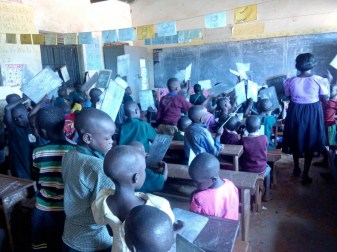
A P1 teacher managing her class of 126 pupils during a reading/writing lesson – she walks around to give pupils individual feedback during writing time. You can’t see many of the children in the photo. 

On Thursday I visited a local primary school to observe early literacy (reading/writing) lessons and give teachers some feedback. I started with sitting at the back of P1 class (first year of primary). The day’s attendance was noted on the board – total: 126. There were four rows of benches (rather than the standard three), to try and squeeze in all the children present. The middle two rows were pushed together and were impassable. There were possibly a good 40-50 children that the teacher had no access to. There were about 10 children on the floor out the front of the class (no room left on the benches). I could see learning charts glued to the cement walls with my handwriting on them from three years ago (I guess the alphabet doesn’t really change, lol).

The teacher did quite an incredible job of managing those 126 children (without any assistance from another teacher). She beautifully followed all the steps we had trained her in and it was so encouraging to see children reading and writing independently on slates.

The pace of the lesson was slow – but that is to be expected How do you attempt to give 126 learners individual feedback day-in, day-out when you are the only one in the class? But she did a pretty awesome job of it! The teacher did comment on the class size, how it was difficult to manage (understatement), and if she had about 90 how much better that would be.

P2 was a similar story, although there were 110 children in the class, a little less crowded than P1. During my individual conversations with the teachers I enquired about the reason for the large class sizes. Both their responses matched my thinking: money. The school gets 5000 shillings each child as an ‘entrance/administration’ fee (£1.10, and around AUS$1.80). Schools also get a ‘grant’ from the government based on enrolment, at around 7500 shillings per child for the year (£1.70; $2.70). The more children in the school, the more money the school receives. Easy logic, simple motivation. Sadly, considering the impact class size has on the quality of education does not surface in discussions.

In Uganda, the pupil-teacher ratio is at 55:1 – 55 pupils for one teacher. Clearly 126 is a little over that and 126 was the number present that day – there were more than 140 on the register. Schools justify large class sizes by employing two teachers for one class, claiming that they can then double the class size and easily have 110 children in one class. But 140 is still well beyond that.

During my long discussion later with the school’s deputy on how to possibly improve reading and writing at the school; I ended with the discussion on enrolment. I enquired why the class size in P1 was so large and he replied that the school couldn’t deny children a place; they would be taken to the ‘authorities’ for denying children a place in the school. The irony is, you can also be taken to the ‘authorities’ for beating a child, charging school fees and having long school hours beyond the government timetable…

The horn is your friend…

This week we took a little two-day break away and I did my share of driving – still gaining confidence driving on Ugandan roads. With Dan as my instructor/critique, here are the top three tips I could now pass on:

  • Always drive in the middle of the road; only go to your side when another car is coming.
  • “The horn is your friend” – Dan’s words exactly. Honk, and people and motorbikes will get out of your way.
  • Never swerve for an animal. Goats, chickens, etc, no swerving. But if it’s a cow, then don’t drive straight into it, try and hit it at an angle.

Jody

Registered!

After months of writing letters, visiting government departments, and waiting, we are now an official non-government organisation registered in Uganda. READ (Reading Education and Development) For Life is official! Although this certificate is dated from a couple of months ago, we just got it back from the NGO Board in Kampala.
Excited and daunted that we have now become an NGO. With it comes responsibility and accountability; as well as opportunities to apply for grants for our work; to give our staff contracts under a recognised organisation; to have a voice as a unified and recognised organisation (not just I work with Jody, lol); and to partner with other organisations for greater change.

However we will not be like many other NGOs operating in Uganda… stay with us on this journey to find out why.

Registration

Rain in the drought

Let’s just say I was a little grumpy yesterday. We hadn’t had any water for more than a week. That’s me on my white-privilege horse neighing that. For the past week we have lived a little like 90% of the population around us, except for it wasn’t us lugging the 20-litre jerry cans of water from the bore hole, we had people helping us do that. (I almost don’t think my local friends wouldn’t allow me anyway, take one look at me: You can’t lift that, you’re too weak, let me help you). Nevertheless, we have been rationing our water big time and now I’m longing to stand under a shower!

The shower came yesterday afternoon when we received a package of books for Myron from Dan’s awesome cousins in the UK. You guys rock! Since Myron has arrived we have received a smattering of lovely packages from our dear friends and some family members and it is so so encouraging to receive. And books – our favourite! There’s only a handful of children’s storybooks available in Gulu so we were pretty stoked to receive these latest editions. I don’t know who was more excited, Myron or me! Looking forward to story time this week.  Books

Moving day…

Today is International Women’s Day. Feeling a little reflective on women in Uganda, how strong and resilient they are; yet how often they are not valued, appreciated and loved as they should be.

After a somewhat emotional conversation with our neighbour last night, this morning she returned with her belongings to store them in one of our rooms until she moves back to her family. She is one of three wives and her husband has asked her to leave. What is the reason? After many years of marriage she has ‘failed to produce’. I hear this happening too often in our parts. Breaks you, there is nothing you can do to ‘fix’ this problem. Also makes you appreciate parts of your worldview where women are valued for far more than their reproductive ability.

Please pray for women in Uganda. Pray that regardless of their current situation, they will remain strong and know the love of their true Father. Pray for Ugandan men, that they would learn to love their wives as Christ loves the Church.

NB: This is not the situation for all Ugandan husbands and wives, but nonetheless is a common occurrence. 

Happy dance!

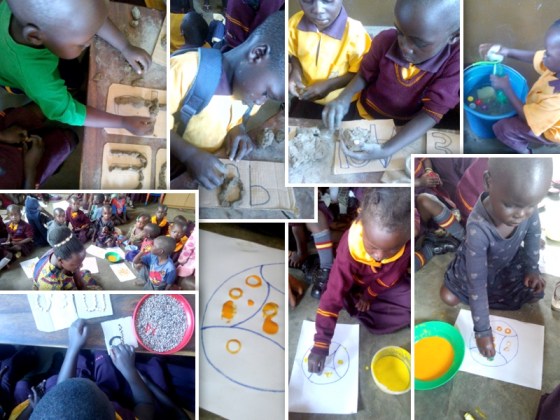
I felt like doing the biggest ‘happy dance’ today after observing two lessons in one of our local nursery schools. Teachers had attended our training sessions on more creative teaching practises and were very keen to show me how they had adapted their teaching. I was absolutely blown away to see 60 three-year-olds painting in one room; and then 110 four-year-olds in one room completing one of four ‘stations’: local clay station working on letters and shapes; a gluing station gluing seeds and popcorn onto templates of pictures and letters; a fine gross motor skills station with water; and an imaginative free play/music station led by one of the teachers.

This is one reason why I love being here 🙂

I left feeling completely encouraged and motivated to continue work with local teachers, not only on improving literacy standards, but in more creative teaching practises. It’s possible and oh so wonderful when you see it in action.

lightray

And it begins again…

And university begins again… praying for some incredible juggling and time management skills!

screen-shot-2017-03-01-at-8-06-38-am

Australian headlines…

Hitting the headlines across regional Australia. Click here to read the article online.

screen-shot-2017-02-27-at-9-19-23-pm